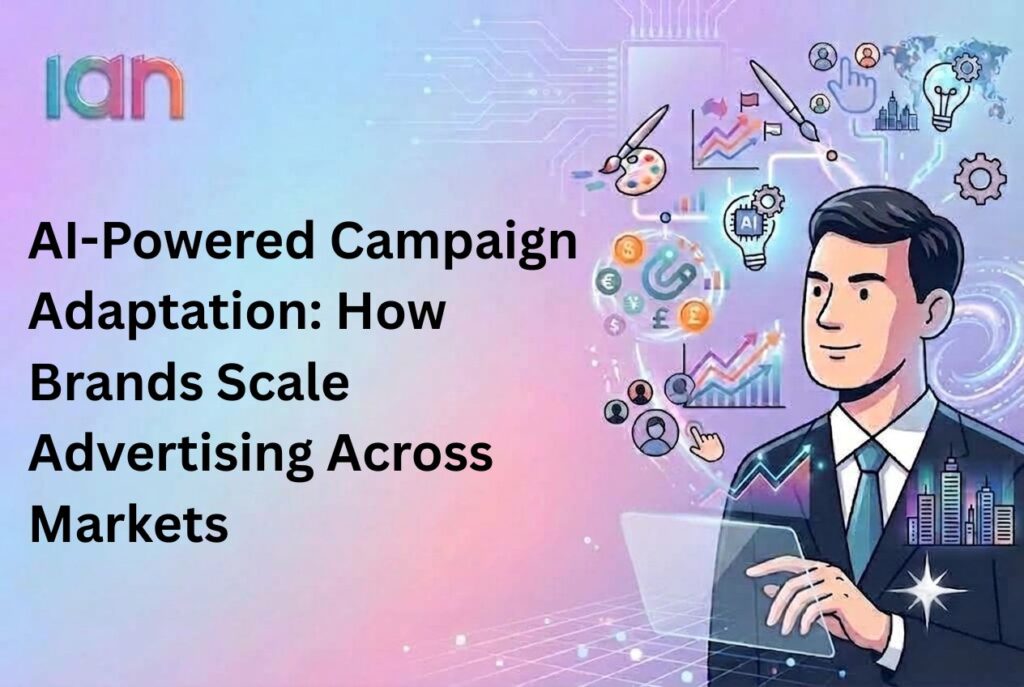
AI-Powered Campaign Adaptation
As brands expand into new cities, regions, and countries, advertising campaigns rarely remain exactly the same. A campaign that works in one market may need changes in language, visuals, messaging, formats, cultural references, or even the way a product is presented.
Traditionally, adapting one campaign for multiple markets required significant manual effort. Creative teams had to produce different versions of advertisements, while marketers, translators, designers, video editors, and production teams worked across multiple formats and platforms.
Artificial intelligence is changing this process.
AI advertising campaign adaptation enables brands to create, modify, localize, and scale campaign assets more efficiently while maintaining the core identity of the original campaign. From creative adaptation and campaign versioning to regional language, video, social media, OOH, and packaging adaptations, AI is becoming an important part of modern advertising workflows.
For brands operating across multiple markets, the opportunity is not simply to produce more advertising. It is to make advertising more relevant to each audience without losing consistency at scale.
What Is AI Creative Adaptation?
AI creative adaptation is the use of artificial intelligence to modify existing advertising creatives for different audiences, markets, channels, languages, and formats.
Instead of developing every creative asset from scratch, brands can use an existing campaign as the foundation and adapt its components according to market requirements.
These adaptations can include:
- Copy and headline variations
- Regional language versions
- Different image compositions
- Market-specific visual elements
- CTA changes
- Different aspect ratios
- Video edits
- Social media versions
- Display advertising formats
- OOH creative variations
- Packaging artwork
- Product messaging
For example, a single global campaign may require separate versions for Delhi, Mumbai, Dubai, Singapore, and London. The central brand idea can remain consistent while the execution is adapted to each market.
This is where AI creative adaptation can help reduce repetitive production work and accelerate the creation of market-specific assets.
How AI Helps Brands Localize Advertising Campaigns
Localization goes beyond translating words.
A successful localized advertising campaign needs to consider language, cultural context, consumer behavior, imagery, references, pricing communication, regulations, and local preferences.
AI can support several stages of this process.
1. Language adaptation
AI can help generate or modify advertising copy for different languages and regional audiences.
2. Cultural adaptation
Creative elements can be reviewed and adapted to make campaigns more relevant to local audiences.
3. Market-specific messaging
A central campaign message can be transformed into variations based on different audience segments or market characteristics.
4. Creative resizing and reformatting
A campaign originally designed for one channel can be adapted for multiple digital and advertising formats.
5. Faster production cycles
Instead of manually producing every version from the beginning, teams can establish a master creative and develop multiple adaptations from it.
However, AI should not be treated as a replacement for human review. Cultural nuance, brand guidelines, legal requirements, and market-specific communication still require human oversight.
AI Campaign Versioning: Creating Multiple Ad Variations at Scale
One of the biggest applications of AI in advertising is campaign versioning.
A single campaign may need dozens or even hundreds of creative variations. These could differ by:
- Audience
- Location
- Language
- Product
- Offer
- Platform
- Creative format
- CTA
- Visual treatment
- Customer segment
AI can help advertising teams create and organize these variations faster.
For example, an e-commerce brand launching a seasonal campaign could create different versions for:
Market → Audience → Product → Language → Platform → Format
Instead of treating every combination as an entirely new creative project, teams can establish a modular campaign system.
This approach makes advertising production more scalable while helping brands maintain a consistent creative direction.
For an AI advertising campaign adaptation workflow, campaign versioning can therefore become an important bridge between creative strategy and large-scale execution.
AI-Powered Regional Language Advertising
Language is one of the most important factors in advertising localization.
For brands operating across India, for example, a campaign may need English, Hindi, Bengali, Tamil, Telugu, Marathi, Kannada, Malayalam, Gujarati, Punjabi, or other regional-language versions depending on the target audience.
AI can assist with:
- Translation
- Transcreation
- Headline adaptation
- CTA variations
- Subtitle generation
- Voiceover preparation
- Social media copy
- Regional campaign messaging
But effective regional-language advertising requires more than literal translation.
The tone, cultural references, expressions, and communication style may need to change while preserving the original brand message.
This makes human review particularly important when using AI-powered advertising workflows for regional campaigns.
How AI Helps Adapt Video Ads for Different Markets
Video advertising often requires significantly more production work than static creative.
A single video campaign may need different:
- Languages
- Voiceovers
- Subtitles
- Product shots
- Text overlays
- Aspect ratios
- Durations
- End cards
- CTAs
- Market-specific messaging
AI can help streamline parts of this adaptation process.
For example, a master video could be adapted into multiple versions for YouTube, Instagram, connected TV, digital displays, and other channels.
AI-assisted workflows can support tasks such as transcription, subtitle generation, voice adaptation, script modification, scene selection, and format conversion.
This does not mean every video can be automatically localized without human involvement. Brand tone, cultural sensitivity, visual continuity, and production quality still need to be reviewed.
The larger opportunity is to make video adaptation more scalable.
AI for Social Media Creative Adaptation
Social media creates another layer of complexity for brands.
A campaign may need different creative formats for Instagram, Facebook, LinkedIn, YouTube, short-form video platforms, and other channels.
Each platform has its own:
- Dimensions
- Content formats
- Audience behavior
- Caption requirements
- Creative conventions
- Video duration preferences
- Engagement patterns
AI can help brands transform a campaign into multiple social media assets without rebuilding every creative manually.
For example, one campaign concept could become:
Master campaign → Short-form video → Story creative → Carousel → Static post → Display banner → Social copy
This allows brands to increase creative output while maintaining a common campaign identity.
For businesses working with an AI advertising agency, this type of workflow can also connect campaign strategy, creative production, adaptation, and distribution more efficiently.
AI-Powered Multi-Format Advertising Adaptation
Modern advertising campaigns rarely exist in a single format.
A campaign can appear across:
- Digital banners
- Social media
- Websites
- Mobile advertising
- Video platforms
- OOH
- Retail displays
- Packaging
- Landing pages
Creating each version manually can increase production time and costs.
AI-powered advertising workflows can help transform a master creative into multiple formats while preserving essential brand elements such as
- Logo
- Typography
- Brand colors
- Product positioning
- Key messaging
- Visual hierarchy
- CTA
This creates a more systematic approach to multi-format advertising adaptation.
Instead of thinking about each asset as an individual production requirement, brands can treat the campaign as a flexible creative system.
AI for OOH Advertising Adaptation
Out-of-home advertising requires creative designs around physical environments.
Billboards, transit advertising, digital screens, retail displays, airport advertising, and other OOH formats have different viewing conditions and dimensions.
AI can assist with adapting campaign assets for different OOH placements.
Potential applications include:
- Billboard resizing
- Digital screen adaptations
- Headline variations
- Location-specific messaging
- Multiple aspect ratios
- Transit advertising formats
- Regional creative variations
For example, the same campaign concept could use different messaging near an airport, shopping district, university, or business hub.
The strategy remains consistent, while the creative execution can be adapted to the location and audience.
Human creative direction remains essential because OOH advertising depends heavily on context, visibility, simplicity, and real-world placement.
AI for Packaging Creative Adaptation
Packaging presents a different adaptation challenge.
Unlike digital advertising, packaging must work within physical dimensions and often involves regulatory, language, product, and market-specific requirements.
Brands entering different markets may need changes to:
- Product information
- Languages
- Legal text
- Claims
- Product descriptions
- Visual hierarchy
- Barcode information
- Market-specific instructions
- Promotional messaging
AI can support the early stages of packaging adaptation by helping teams generate copy variations, organize information, explore layouts, and manage multiple versions.
However, packaging adaptations should go through appropriate regulatory, legal, design, and production checks before final approval.
Why AI Advertising Campaign Adaptation Matters for Global Brands
The biggest advantage of AI is not simply speed.
It can help brands build a more scalable and efficient creative production model. For example, when a brand enters five different markets, uses three languages, and promotes its campaign across four major advertising formats, the number of creative variations can quickly increase. Under a traditional workflow, managing these requirements can involve significant time, coordination, and production effort.
With an AI-assisted adaptation workflow, the brand can establish:
One master campaign → Multiple market adaptations → Multiple language versions → Multiple formats → Multiple channel assets
This can help creative teams focus more of their time on strategy, storytelling, creative direction, and quality control rather than repetitive production tasks.
Key benefits include:
Greater scalability: More creative versions can be developed without increasing production work at the same rate.
Faster localization: Market-specific versions can move through production more efficiently.
Better consistency: Centralized campaign guidelines can help maintain brand identity across adaptations.
More creative variations: Teams can test different messages, formats, and executions.
Improved workflow efficiency: Repetitive adaptation tasks can be partially automated.
Multi-market flexibility: Campaigns can be adapted for different regions without rebuilding the entire concept.
AI Advertising Agency vs. Traditional Advertising Workflows
AI does not necessarily eliminate the need for advertising agencies. Instead, it is changing how agencies approach production.
A traditional advertising workflow may involve:
Brief → Concept → Creative → Production → Adaptation → Review → Delivery
An AI-assisted workflow can introduce automation into several stages:
Brief → Strategy → Master Creative → AI-Assisted Adaptation → Human Review → Optimization → Multi-Format Delivery
The important distinction is that AI can assist with execution, while human teams continue to provide strategic thinking, creative direction, cultural understanding, brand governance, and quality control.
An AI advertising agency therefore does not simply mean an agency that uses AI-generated content. It can mean an agency that integrates AI into a broader advertising production and adaptation system.
What Role Does an AI Brand Agency Play?
An AI brand agency can combine brand strategy with AI-enabled creative workflows.
This can be particularly useful for brands that need to maintain consistency across multiple markets.
The process may involve:
- Defining the central brand message.
- Establishing creative and brand guidelines.
- Creating a master campaign.
- Identifying market-specific requirements.
- Developing localized creative variations.
- Adapting content across formats.
- Conducting human quality checks.
- Delivering campaign-ready assets.
The objective is not to make every market look identical.
It is to create a balance between global brand consistency and local market relevance.
How Brands Can Build an AI-Powered Campaign Adaptation Workflow
Brands considering AI advertising services can begin with a structured workflow rather than attempting to automate everything immediately.
Step 1: Create a master campaign.
Establish the central creative concept, messaging, visual identity, and brand guidelines.
Step 2: Identify adaptation requirements
Map each market, language, audience, platform, and format that requires a separate version.
Step 3: Separate reusable creative elements.
Identify components such as headlines, images, videos, CTAs, product information, and graphics that can be modified independently.
Step 4: Introduce AI-assisted production
Use AI where it can reduce repetitive work, such as copy variations, translation support, resizing, transcription, subtitles, and creative versioning.
Step 5: Add human review
Check every adaptation for brand consistency, cultural relevance, accuracy, legal requirements, and creative quality.
Step 6: Test and optimize
Use campaign performance data to understand which creative variations resonate with different audiences.
This creates a continuous cycle:
Create → Adapt → Launch → Measure → Learn → Adapt Again
The Future of AI Advertising Campaign Adaptation
Advertising is moving from a model based on creating a few large campaign assets toward a model built around creative scalability.
As AI tools become more integrated into advertising workflows, brands may increasingly operate with modular campaign systems where a central creative idea can be adapted across markets, audiences, languages, formats, and channels.
The future is unlikely to be about choosing between humans and AI.
Instead, successful advertising workflows are likely to combine:
Human strategy + creative thinking + AI-assisted production + market expertise + data-driven optimization
For advertising agencies and brands alike, this creates an opportunity to make global campaigns more flexible without sacrificing brand identity.
How Infinity Advertising Network Approaches AI-Powered Campaign Adaptation
For brands managing campaigns across multiple markets and formats, adaptation can become one of the most resource-intensive stages of advertising production.
Infinity Advertising Network approaches adaptation as a structured creative process rather than simply creating multiple resized versions of an existing advertisement.
Its adaptation-focused approach can support areas such as creative adaptation, video adaptation, social media adaptation, campaign versioning, regional-language adaptation, multi-format adaptation, OOH adaptation, and packaging adaptation.
The broader objective is to help brands take a core campaign idea and adapt it for different audiences, channels, markets, and communication requirements while maintaining the campaign’s overall creative direction.
As AI continues to reshape advertising production, combining technology with human creative judgment can help brands build campaigns that are both scalable and locally relevant.
Frequently Asked Questions
What is AI advertising campaign adaptation?
AI advertising campaign adaptation is the use of artificial intelligence to modify advertising campaigns for different markets, audiences, languages, platforms, and creative formats. It can support tasks such as copy adaptation, creative versioning, localization, video adaptation, and multi-format production.
What is AI creative adaptation?
AI creative adaptation uses AI-assisted tools and workflows to modify existing advertising creatives for different audiences, markets, languages, platforms, and formats while maintaining core brand and campaign elements.
How does AI help localize advertising campaigns?
AI can assist with translation, transcreation, regional messaging, creative variations, subtitles, voiceovers, and market-specific content. Human review remains important for cultural context, brand tone, and accuracy.
Can AI create multiple versions of the same advertising campaign?
Yes. AI-assisted workflows can help generate variations of headlines, visuals, formats, languages, CTAs, and other creative elements. These variations can then be reviewed and approved by creative and marketing teams.
How can AI help brands scale advertising across markets?
AI can reduce repetitive production work by helping teams adapt a master campaign into multiple market, language, platform, and format variations. This can make large-scale campaign localization more manageable.
Can AI adapt video advertising for different languages?
AI can support video adaptation through transcription, subtitles, translated scripts, voiceover workflows, and other production tasks. Final versions should be reviewed for language accuracy, cultural suitability, brand tone, and production quality.
What is AI-powered regional language advertising?
AI-powered regional language advertising involves using AI-assisted workflows to adapt campaign copy, scripts, subtitles, voiceovers, and other creative elements for specific regional languages and audiences.
How does AI help with social media creative adaptation?
AI can help transform a master campaign into different social media formats, including short-form videos, stories, static posts, carousels, captions, and platform-specific creative variations.
Can AI be used for OOH advertising adaptation?
Yes. AI-assisted workflows can help adapt advertising creatives for different billboard, transit, digital-screen, retail, and other OOH formats. Location-specific messaging can also be developed, subject to human creative review.
How can AI help with packaging creative adaptation?
AI can assist packaging teams with copy variations, language adaptation, information organization, and creative exploration. Packaging adaptations still require appropriate design, regulatory, legal, and production checks.
Does AI replace advertising agencies?
AI can automate or accelerate certain advertising production tasks, but advertising still requires strategy, creative direction, brand understanding, cultural judgment, and quality control. AI is increasingly being integrated into agency workflows rather than simply replacing the agency function.
Final Thoughts –
The next phase of advertising is not simply about producing more content. It is about creating adaptable campaigns that can work across markets without losing their original identity.
AI advertising campaign adaptation gives brands a way to scale creative production across languages, audiences, channels, and formats. When combined with human strategy and creative oversight, it can turn one campaign concept into a flexible ecosystem of market-ready advertising assets.
For brands expanding across regions or managing large multi-market campaigns, AI-powered adaptation can become an important part of building a faster, more scalable, and more locally relevant advertising operation.