AI-Powered Creative Advertising
Advertising has always been about connecting with people through ideas that capture attention, create emotion, and make brands memorable. But in 2026, the creative process is changing. Brands are expected to produce more content, adapt campaigns for different audiences, and respond quickly to changing consumer preferences—all while maintaining a consistent identity.
This is where AI creative advertising is creating new opportunities.
Artificial intelligence can help marketers explore concepts, generate visual directions, develop creative variations, and adapt campaign assets for different platforms. Tasks that once required considerable manual effort can now be supported by AI-powered tools, giving creative teams more opportunities to experiment and refine their ideas.
However, faster production does not automatically mean better advertising. A campaign still needs a meaningful idea, a clear message, and an understanding of the people it is trying to reach.
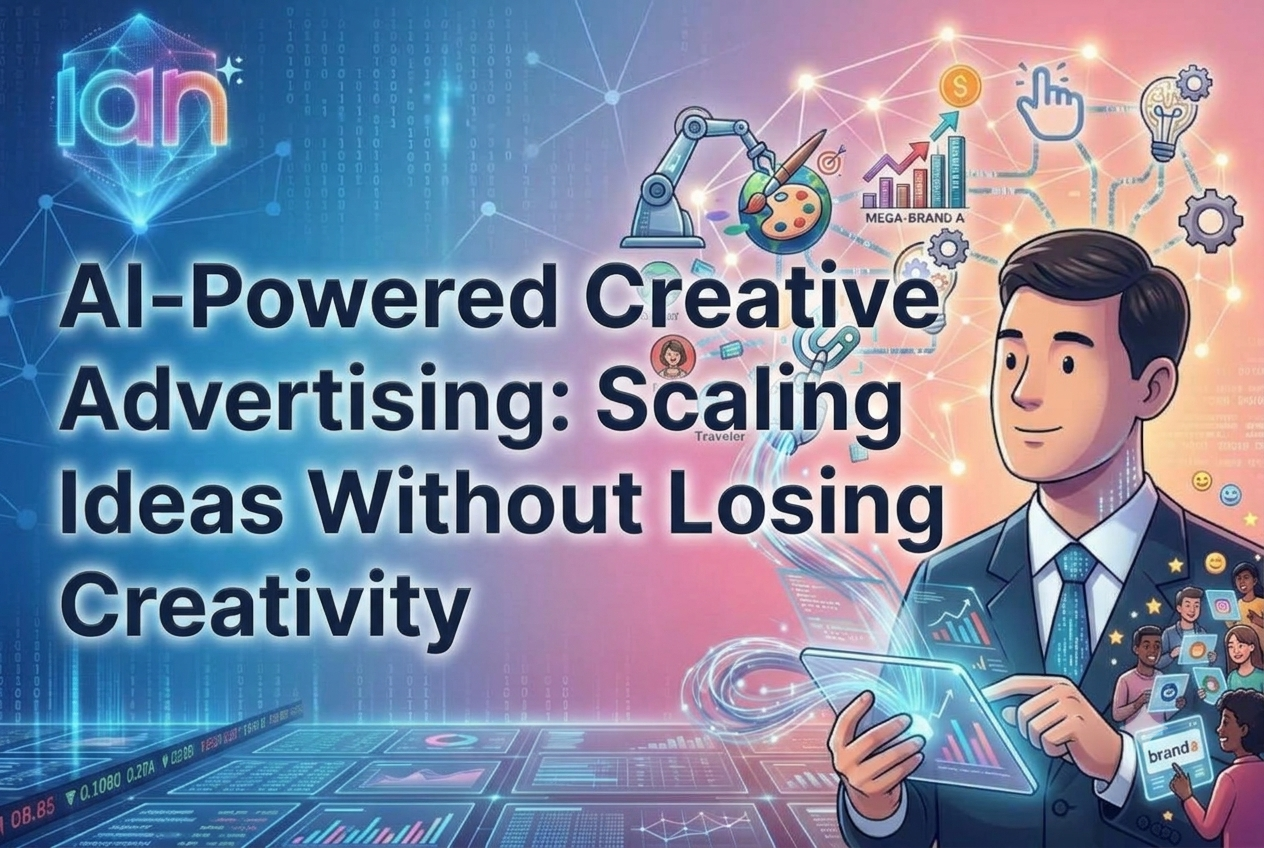
The real opportunity lies in combining AI’s speed with human creativity. For brands and marketing teams, the goal is not simply to produce more advertisements but to create relevant, distinctive and effective campaigns at scale.
For Infinity Advertising Network, this represents an important shift in how brands can approach creative development, campaign adaptation, and multi-platform advertising.
What AI Creative Advertising Means in 2026
AI creative advertising refers to the use of artificial intelligence to support the development, production, adaptation and optimisation of advertising content.
It can involve generating initial concepts, exploring visual styles, drafting copy, producing creative variations, adapting content for different formats and analysing campaign performance.
For example, a brand launching a new product may need a hero campaign, social media advertisements, digital banners, video creatives and versions for different audience segments. AI-assisted workflows can help teams explore more creative directions and prepare variations more efficiently.
AI can support several stages of the process:
- Creative ideation: Exploring campaign concepts, headlines and messaging directions.
- Visual development: Creating mood boards, reference imagery and early visual concepts.
- Content production: Assisting with copy, graphics, video elements and other creative assets.
- Campaign adaptation: Resizing, rewriting or adjusting approved creative concepts for different formats and markets.
- Creative testing: Helping teams organise and compare different versions of advertising assets.
The exact capabilities depend on the tools used and the level of human involvement. AI is most useful when it supports a defined creative objective rather than generating content without a clear strategy.
Real the relevant blog post – Brands Turn to Creative Advertising for Greater Impact
Why Brands Are Adopting AI for Creative Development
Brands are increasingly managing campaigns across multiple digital platforms, languages, audience groups and advertising formats. Creating every asset independently can make the process time-consuming and difficult to scale.
AI can help address this challenge by supporting faster experimentation and reducing repetitive production work.
More creative directions to explore
Instead of beginning with a single concept, creative teams can use AI to explore different messaging angles, visual styles and storytelling approaches. These initial ideas can then be reviewed and developed into stronger campaign concepts.
Faster campaign development
AI-assisted tools can help with early drafts, reference visuals, copy variations and production support. This can reduce some repetitive tasks and allow creative professionals to focus on refining the final work.
Greater content flexibility
A campaign may need different versions for social media, websites, digital advertising, video platforms and regional markets. AI can support the process of adapting approved creative assets to these requirements.
More opportunities for experimentation
Brands can develop alternative headlines, calls to action and visual approaches for testing. Rather than assuming that the first concept will perform best, teams can use structured experimentation to learn what resonates with their audiences.
However, these advantages depend on the quality of the brief, the tools selected and the review process. AI can accelerate execution, but it cannot guarantee that a campaign will connect with customers or deliver better business results.
How AI Supports Ideation, Visual Production and Campaign Adaptation
One of the biggest advantages of AI-powered creative advertising is its ability to support multiple stages of the creative workflow.
Ideation: Moving from a brief to creative possibilities
A strong campaign begins with a clear understanding of the brand, audience and communication objective. AI can help teams brainstorm concepts, explore alternative messages and organise ideas around a central campaign theme.
Human creative teams then evaluate which directions are original, relevant and aligned with the brand.
Visual production: Exploring ideas before final execution
AI tools can help generate visual references, mood boards, background concepts and preliminary creative layouts. These can be useful when evaluating a visual direction before investing in full-scale production.
Final assets still require appropriate design judgement, technical quality checks and attention to brand guidelines.
Campaign adaptation: Making one idea work across channels
A campaign that works as a wide-screen video may need a different composition for a vertical social media placement. A headline written for one audience may also need adjustment for another market.
AI can help generate or adapt versions, but each asset should be reviewed to ensure that the original message, visual hierarchy and brand identity remain intact.
For brands managing campaigns across multiple formats and markets, this combination of AI assistance and human review can make creative adaptation more manageable.
How Brands Can Personalise Creative Assets Across Audiences
Personalisation allows brands to make advertising more relevant to different audience needs, interests and contexts.
AI can support this process by helping teams develop alternative messages, creative variations and content formats based on campaign requirements. For example, a fitness brand might emphasise convenience for one audience and performance for another while maintaining the same core brand proposition.
A practical workflow could include:
- Define the audience segments and campaign objective.
- Establish the core message and approved brand guidelines.
- Develop creative variations for different audience needs.
- Adapt the assets for relevant platforms and formats.
- Test the variations using appropriate campaign metrics.
- Review the results and refine future creative decisions.
Personalisation should not mean creating unrelated messages for every audience. The most effective approach balances relevance with a consistent brand identity.
Brands must also respect privacy requirements, use customer data appropriately and avoid personalisation that feels intrusive or relies on sensitive assumptions.
How AI Helps Test and Optimise Advertising Creatives
Creative performance can vary depending on the audience, platform, placement, message and campaign objective. A visual that attracts attention may not necessarily generate enquiries or sales.
AI can assist creative optimisation by helping teams generate alternative assets, organise experiments and identify patterns in campaign data. Depending on the advertising platform and tools used, AI may also support automated delivery and optimisation.
Brands can test different elements, including:
- Opening hooks and headlines
- Product images and visual styles
- Video lengths and opening scenes
- Calls to action
- Message emphasis
- Creative formats
- Audience-specific variations
For meaningful results, teams should change test variables systematically and evaluate performance against the campaign objective.
For example, a brand focused on awareness may examine reach and completed video views, while a lead-generation campaign may focus on qualified enquiries and cost per lead.
AI can help accelerate analysis, but results still need to be interpreted carefully. Creative testing is most valuable when it produces actionable insights rather than simply identifying the advertisement with the highest number of clicks.
AI-Generated Content Versus Human-Led Creativity
AI-generated content and human-led creativity serve different but complementary purposes.
AI can generate options quickly, identify patterns and support repetitive production tasks. Human creative professionals bring cultural understanding, emotional intelligence, strategic judgement and the ability to recognise whether an idea feels distinctive or appropriate for a particular brand.
Consider a campaign built around a cultural festival. AI may help generate visual concepts, headlines and format variations. But a creative team needs to understand the cultural context, audience expectations and potential sensitivities before deciding which concept should be published.
The distinction becomes especially important when brands are trying to build long-term recognition rather than simply produce individual advertisements.
| Area | AI-assisted contribution | Human contribution |
| Ideation | Generates concept options | Selects and develops the strongest idea |
| Copywriting | Produces initial drafts and variations | Refines tone, meaning and persuasion |
| Visual development | Explores styles and compositions | Directs the visual identity and execution |
| Adaptation | Helps prepare multiple formats | Protects context and brand consistency |
| Optimisation | Supports analysis and testing | Interprets results and makes strategic decisions |
The best workflow is not about choosing one over the other. It is about using AI where it adds value while retaining human ownership of the creative direction.
Risks Involving Brand Consistency, Authenticity and Intellectual Property
Although AI offers significant creative opportunities, brands should consider the risks before integrating it into advertising workflows.
Brand consistency
AI-generated assets may introduce inconsistent colours, typography, product details or visual styles. Approved brand guidelines, reusable templates and human review help maintain consistency.
Authenticity and trust
Content that looks artificial, misleading or disconnected from a brand’s real values can undermine trust. Brands should be transparent where appropriate and avoid presenting synthetic imagery or endorsements in ways that mislead audiences.
Intellectual property
AI-generated content can raise questions about training data, copyright, licensing and ownership. Businesses should review the terms of their chosen tools, confirm rights for commercial use and obtain appropriate permissions for third-party assets.
Accuracy and representation
AI-generated copy and visuals may contain incorrect information, unrealistic product representations or unintended cultural biases. All material claims and final assets should be reviewed before publication.
Privacy and data protection
Teams should avoid entering confidential business information or personal data into AI systems unless the tools and processes are approved for that use.
A responsible AI workflow includes clear approval processes, documented asset rights and accountability for the final advertisement.
How to Choose an AI Creative Advertising Agency
Choosing an AI creative advertising agency requires looking beyond whether it uses the latest AI tools. The more important question is whether the agency can turn technology into creative work that supports a business objective.
Before selecting a partner, consider the following:
1. Creative strategy: Does the agency understand your audience, positioning, campaign goals and brand voice?
2. AI capabilities: Can it explain where AI will improve the workflow and where human expertise remains necessary?
3. Production experience: Can the team deliver the required formats, from digital banners and social creatives to video and campaign assets?
4. Brand governance: Does it have a process for reviewing visual consistency, claims, permissions and final quality?
5. Adaptation capabilities: Can it help develop assets for multiple platforms, formats, languages or markets?
6. Measurement: Can it connect creative testing with meaningful campaign metrics instead of relying on vanity metrics alone?
7. Collaboration: Is the team able to work with internal marketing departments, brand managers and existing production partners?
An effective agency should be able to explain its creative process, provide relevant examples and establish clear responsibilities for AI-generated and human-created work.
How Infinity Advertising Network Can Support AI-Powered Creative Advertising
For brands, AI is most valuable when it becomes part of a well-planned creative and advertising process rather than an isolated production tool.
Infinity Advertising Network can be positioned around the connection between creative thinking, advertising strategy and scalable campaign execution. The opportunity is to help brands think beyond individual advertisements and consider how a central campaign idea can be developed into a consistent set of assets for different platforms and audiences.
This approach can bring together creative concept development, visual communication, campaign adaptation and multi-format content requirements.
For example, a brand may begin with one approved campaign direction and then need social media creatives, digital banners, video variations and market-specific versions. AI-assisted workflows can help explore and prepare those variations, while creative review helps protect the message and brand identity.
The objective is not to use AI simply because it is available. It is to use the right tools where they can support a clear creative purpose, improve workflow efficiency and give the campaign more flexibility.
Final Thoughts: Scaling Creative Ideas Without Losing the Human Touch
AI is changing how advertising ideas are explored, developed, adapted and tested. It gives brands more ways to experiment, produce creative variations and manage campaigns across an increasingly complex media environment.
But scale alone is not a competitive advantage. If every brand relies on similar prompts, visual styles and automated outputs, advertising risks becoming repetitive and interchangeable.
The brands that stand out will be those that combine AI capabilities with strong creative strategy, distinctive storytelling and a clear understanding of their audiences.
For businesses exploring AI creative advertising, the next step is to identify where AI can genuinely improve their creative process while keeping people responsible for the decisions that shape brand identity and customer trust.
With a strategy-led approach, Infinity Advertising Network can be part of that conversation—helping brands explore how creative development, campaign adaptation and advertising execution can work together in an AI-enabled marketing environment.
The future of creative advertising is not about replacing creativity with automation. It is about giving good ideas more opportunities to reach the right people, in the right format, at the right time.
Frequently Asked Questions
What is AI creative advertising, and how does it work?
AI creative advertising uses artificial intelligence to support advertising concept development, copywriting, visual creation, campaign adaptation and creative testing. Marketers provide the brief, audience information and brand guidelines, then use AI-assisted tools to generate or refine options. Human review remains essential to ensure accuracy, originality and brand consistency.
How is AI changing creative advertising in 2026?
AI is helping creative teams explore more concepts, produce content variations, adapt assets for different platforms and support campaign testing. It can reduce some repetitive work and make creative workflows more flexible. However, strategy, storytelling, cultural understanding and quality control remain important to producing effective advertising.
What are the benefits of using AI in advertising creative development?
Potential benefits include faster ideation, more creative variations, support for content adaptation, streamlined production tasks and more structured creative testing. The results depend on the tools, workflow and review process. AI does not automatically guarantee stronger engagement or better campaign performance.
Can AI generate original advertising concepts and campaign ideas?
AI can generate concept options, headlines, scripts and visual directions based on a brief. However, the output may resemble existing ideas or lack the context needed for a distinctive campaign. Creative teams should evaluate originality, relevance, brand fit and intellectual property considerations before using AI-generated material commercially.
How can brands use AI to create advertising campaigns faster?
Brands can use AI to support brainstorming, draft copy, explore visual directions, create asset variations and adapt content for different placements. A clear brief, approved brand guidelines, suitable tools and a defined review process help teams work efficiently without sacrificing quality.
How does AI personalise advertising creatives for different audiences?
AI can help develop variations in messaging, visuals, language and format for different audience segments. Brands should define the audience needs and campaign objective first, then test appropriate creative versions. Personalisation should use data responsibly, respect privacy and maintain a consistent brand identity.