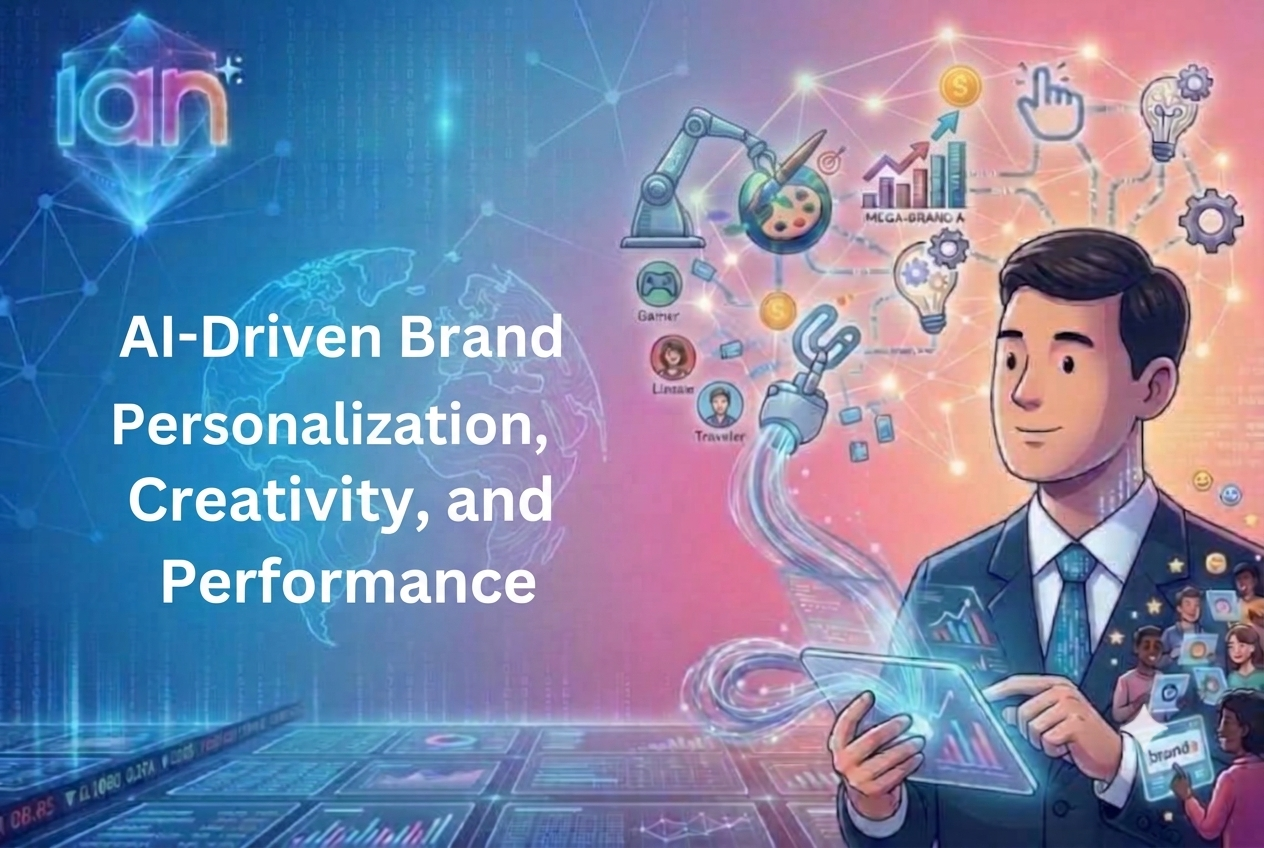
AI-Driven Brand Advertising
Advertising is no longer just about putting a message in front of as many people as possible. Today, brands need to understand their audiences, deliver relevant experiences, and communicate their value across multiple platforms. With changing customer expectations and increasing competition, businesses are looking for smarter ways to make their advertising more meaningful and effective.
This is where AI brand advertising is creating new opportunities. Artificial intelligence can help businesses analyze audience insights, personalize advertising messages, develop creative variations, and understand campaign performance. Instead of relying entirely on manual research and traditional workflows, brands can use AI tools to support faster decision-making and more informed campaign planning.
However, successful advertising still requires more than technology. A strong brand identity, compelling storytelling, human creativity, and a clear understanding of customer needs remain essential. AI works best when it supports these elements rather than replacing them.
For businesses looking to strengthen their advertising approach, Infinity Advertising Network recognizes the importance of combining creative thinking, strategic communication, and evolving advertising technologies to help brands connect with the right audiences.
What Is AI Brand Advertising?
AI brand advertising refers to the use of artificial intelligence technologies to plan, develop, personalize, deliver, and evaluate advertising campaigns. These technologies can analyze data, identify patterns, generate creative options, and support decisions about how advertising messages are presented to different audiences.
For example, a business launching a new product may use AI tools to explore customer interests, develop alternative advertising headlines, create visual concepts, or identify which campaign messages deserve further testing.
Similarly, a brand running campaigns across social media, video, search, and display advertising can use AI-assisted tools to adapt creative assets to different formats and audience segments.
AI-powered brand advertising can support several activities, including:
- Audience research and behavioural analysis
- Advertising copy and creative concept development
- Personalized messaging and content recommendations
- Creative adaptation for different platforms
- Campaign testing and performance analysis
- Advertising optimization and reporting
The objective is not simply to use AI because it is new. It is to apply the technology where it can improve efficiency, strengthen relevance, or provide useful insights.
When supported by a clear strategy and appropriate human oversight, AI can help businesses develop advertising campaigns that are more aligned with their brand objectives and customer expectations.
How Is Artificial Intelligence Changing Brand Advertising?
Artificial intelligence is changing advertising workflows by helping brands process information, explore creative possibilities, and respond to campaign data more efficiently.
1. More Informed Audience Insights
Understanding an audience is one of the foundations of effective advertising. AI-assisted analytics can help businesses identify patterns in customer behaviour, interests, engagement, and campaign interactions.
These insights can help marketers develop a clearer picture of what their audiences may find relevant. For example, a business promoting professional services might use campaign data to understand which messages generate more qualified enquiries.
However, AI predictions are only as useful as the data and assumptions behind them. Businesses should validate insights against reliable information rather than treating automated recommendations as unquestionable facts.
2. Faster Creative Development
Developing advertising concepts can involve considerable research, brainstorming, writing, design, and revision. Generative AI tools can support parts of this process by producing initial copy variations, exploring visual directions, and helping creative teams develop alternative concepts.
This can give marketers more options to evaluate before choosing the strongest direction.
Human creative professionals remain important for judging originality, emotional relevance, brand suitability, and cultural context. AI-generated ideas should be reviewed and refined before they become public-facing advertising.
3. More Relevant Advertising Experiences
Different audiences may respond to different messages, formats, and product benefits. AI can help businesses explore ways to tailor advertising based on relevant audience signals and campaign requirements.
For example, an advertisement for a fitness product may emphasize convenience for one audience and performance features for another. The core brand promise can remain consistent while the supporting message changes.
Personalization should always respect privacy, consent requirements, and applicable advertising regulations. More targeted communication is valuable only when it remains appropriate and trustworthy.
4. Continuous Campaign Improvement
Advertising performance can change according to the creative, audience, placement, timing, and competitive environment. AI-assisted tools can help analyze campaign data and identify patterns that deserve attention.
Marketers can use these insights to test new creative variations, review underperforming placements, and adjust campaign strategies. Decisions should still consider business objectives, data quality, and the wider customer journey.
Read the relevant blog post—How AI Is Transforming Brand Advertising and Customer Engagement
What Are the Benefits of AI-Powered Brand Advertising?
AI-powered advertising offers several potential benefits when it is used to solve clearly defined marketing challenges.
Improved Personalization
AI can help marketers develop different message variations for relevant audience segments. This allows businesses to make advertising more specific to customer interests without losing sight of the overall brand identity.
Greater Creative Efficiency
AI-assisted tools can speed up early-stage ideation, copy variations, content adaptation, and selected production tasks. Creative teams can then spend more time refining the strongest ideas and ensuring that the final advertising communicates the intended message.
Better Use of Campaign Data
AI can help process large amounts of campaign information and highlight patterns that may be difficult to identify manually. These insights can support more informed decisions about messaging, creative formats, and campaign adjustments.
Scalable Campaign Adaptation
Businesses often need multiple versions of an advertisement for different platforms, markets, languages, or audience groups. AI can assist with adapting selected elements while helping teams manage content production more efficiently.
Every version should still be reviewed for accuracy, tone, cultural relevance, and brand consistency.
More Structured Performance Testing
Marketers can use AI-assisted workflows to explore creative alternatives and identify which variables to test. Comparing headlines, calls to action, visuals, and formats can help businesses learn which combinations work best for their campaign objectives.
These benefits are not automatic. Results depend on the quality of the strategy, creative execution, data, implementation, and ongoing evaluation.
How Does AI Help Brands Reach the Right Audience?
Reaching the right audience means communicating with people whose needs, interests, or circumstances make a product or service relevant to them. AI can support this process by helping marketers analyze available data and organize their advertising decisions.
Audience Segmentation
AI-assisted analysis can help identify meaningful patterns within customer groups. Depending on the data available and the platform being used, businesses may explore differences in interests, engagement, purchase behaviour, or responses to advertising messages.
These segments can guide creative decisions and help marketers develop more relevant campaign variations.
Predictive Insights
Some AI systems use historical data to estimate likely future behaviours or campaign outcomes. Such predictions may help marketers prioritize opportunities or identify audience groups worth testing.
These estimates should not be treated as guarantees. Customer behaviour changes, and predictions can be affected by incomplete data or changing market conditions.
Personalized Messaging
AI tools can help businesses develop different versions of a campaign message for different customer needs. For example, a software company may highlight ease of use for new customers and workflow efficiency for experienced users.
The main brand promise should remain recognizable even when the supporting message changes.
Platform and Format Adaptation
Different platforms have different creative requirements and audience behaviours. AI-assisted tools can help adapt copy, visuals, and video assets to fit selected formats.
This can make it easier to manage multi-channel campaigns while preserving a consistent brand identity.
For an AI brand advertising agency, the challenge is to combine these capabilities with sound creative judgement, clear objectives, and responsible use of customer information.
How Is Generative AI Changing Advertising Creative Development?
Generative AI is influencing how advertising teams explore ideas and produce content. Tools capable of generating text, images, video elements, and other creative assets can support several stages of campaign development.
Generating Initial Creative Concepts
Creative teams can use generative AI to explore campaign themes, headline options, storytelling directions, and visual references. These initial concepts can help stimulate ideas and make brainstorming more efficient.
The strongest results usually come from detailed briefs that explain the target audience, brand personality, key message, campaign objective, and creative limitations.
Creating Advertising Variations
A single campaign may need multiple headlines, descriptions, images, or calls to action. Generative AI can help produce variations for review and testing.
For example, a campaign may use the same core product benefit while presenting different introductory messages across social media and display advertising. Each version should be checked to ensure that it remains accurate and consistent with the brand.
Supporting Video and Visual Production
AI-assisted tools can contribute to storyboarding, script development, visual ideation, and selected production tasks. These capabilities may help creative teams explore different ways to present a product, explain a service, or communicate a brand story.
The appropriate tools depend on the production requirements. High-quality commercial content still needs attention to storytelling, visual quality, sound, licensing, and audience expectations.
Enabling Creative Adaptation Across Markets
Brands operating across different regions may need to adapt advertising to local languages, cultural references, and platform requirements.
Generative AI can support initial translation and adaptation, but local expertise and human review remain important. Literal translation does not always preserve the meaning, tone, humour, or cultural relevance of an advertising message.
This is particularly important when brands want to scale campaigns without making their communication feel generic or disconnected from local audiences.
AI Brand Advertising vs Traditional Advertising
AI-driven and traditional advertising are not necessarily competing approaches. Many effective campaigns combine established marketing principles with AI-assisted tools.
| Factor | AI-Driven Brand Advertising | Traditional Advertising Approach |
| Audience insights | Can analyze large datasets and identify patterns | Often relies more heavily on research, experience, and manual analysis |
| Creative development | Supports rapid generation of ideas and variations | Relies primarily on human-led ideation and production |
| Personalization | Can assist with creating and delivering audience-specific messages | May focus more on broader audience groups or standardized messaging |
| Optimization | Can support frequent analysis and data-informed adjustments | May rely more on scheduled reviews and manual optimization |
| Scalability | Can help adapt content across multiple formats and audiences | Scaling may require additional manual creative and production work |
| Human involvement | Requires creative direction, validation, and oversight | Human judgement typically drives the core process |
The right approach depends on the campaign. Traditional advertising methods can still be effective for storytelling, brand building, and broad-reach communication. AI adds useful capabilities when it improves research, creative workflows, personalization, or measurement.
A thoughtful AI brand strategy focuses on selecting the right tools for the right tasks rather than automating every part of the advertising process.
What Challenges Should Businesses Consider Before Using AI Advertising?
Although AI can create new opportunities, businesses should understand its limitations before integrating it into their advertising workflows.
Protecting Customer Privacy
AI-driven personalization may involve customer data and behavioural insights. Businesses should use data responsibly, follow applicable privacy requirements, and ensure that their targeting practices are appropriate.
Maintaining Brand Consistency
AI-generated content can vary in tone, style, accuracy, and visual quality. Without clear guidelines and review processes, different advertisements may communicate inconsistent brand messages.
Brands should define their voice, visual identity, approved claims, and creative standards before scaling AI-assisted production.
Avoiding Generic Creative Work
AI tools can produce content quickly, but speed does not guarantee originality. Generic messaging may fail to communicate what makes a business distinctive.
Strong creative direction, customer understanding, and meaningful brand storytelling help ensure that advertising remains relevant and memorable.
Checking Accuracy and Authenticity
AI-generated copy or visuals may contain incorrect details or misleading representations. All advertising claims, product information, pricing, and other factual elements should be reviewed before publication.
Businesses should also verify image, video, music, and other asset usage rights, along with any applicable disclosure requirements.
Measuring Real Business Outcomes
An AI-assisted campaign may generate more creative variations or engagement without necessarily producing better business results.
Businesses should measure performance against meaningful objectives, such as qualified enquiries, conversions, customer acquisition costs, or brand awareness. The appropriate metrics depend on the campaign’s purpose.
The most effective approach combines AI’s processing capabilities with human accountability and clear business priorities.
How Infinity Advertising Network Can Help Brands Develop More Effective Advertising Campaigns
Modern advertising requires a balance of creative thinking, audience understanding, consistent brand communication, and appropriate use of technology. AI can support this process, but its value depends on how well it serves the campaign’s purpose.
Infinity Advertising Network understands the importance of connecting brand messaging with the audiences a business wants to reach. Businesses exploring AI-assisted advertising can consider how audience insights, creative development, campaign adaptation, and multi-format communication fit into their broader marketing objectives.
A practical approach to AI brand marketing begins with a few essential questions:
- Who is the campaign intended to reach?
- What should the audience understand or remember?
- Which advertising formats are best suited to the message?
- Where can AI improve the creative or campaign workflow?
- How will the business evaluate the campaign’s effectiveness?
Answering these questions helps ensure that technology supports a meaningful advertising strategy instead of becoming a goal in itself.
For example, a business running a multi-channel campaign may need different creative formats for social media, video, digital placements, and other advertising channels. AI-assisted workflows can help explore content variations, while human creative direction ensures that the message remains relevant and consistent.
For brands considering AI creative advertising, the priority should be to combine efficient content development with distinctive ideas, credible messaging, and a recognizable brand identity.
Infinity Advertising Network can be a starting point for businesses looking to explore advertising and creative communication requirements aligned with their campaign goals.
Frequently Asked Questions About AI Brand Advertising
1. What Is AI Brand Advertising, and How Does It Work?
AI brand advertising uses artificial intelligence to support advertising research, creative development, audience analysis, personalization, and campaign optimization. AI tools process available information or generate content to assist marketers in making decisions. Human oversight remains important for ensuring accuracy, brand consistency, responsible targeting, and creative quality.
2. How Can AI Improve Brand Awareness?
AI can help marketers analyze audience responses, develop creative variations, and identify opportunities to deliver more relevant advertising messages. These capabilities may support better campaign planning and more consistent communication. Brand awareness still depends on factors such as message quality, audience relevance, creative execution, and the consistency of advertising over time.
3. Can AI Help Create Personalized Advertising Campaigns?
Yes. AI can help businesses develop message variations and analyze audience signals to support personalization. For example, brands may highlight different product benefits for different audience segments. Personalization should be based on appropriate data practices and must preserve the brand’s core identity while respecting customer privacy and applicable regulations.
4. Is AI-Generated Advertising Effective for Small Businesses?
AI-generated advertising can help small businesses explore creative ideas, develop initial copy, and produce content variations more efficiently. Its effectiveness depends on the quality of the message, the intended audience, the chosen channels, and the campaign’s execution. Businesses should review AI-generated content carefully and measure results against clear marketing objectives.
5. What Are the Advantages and Limitations of AI in Advertising?
AI can support faster creative development, audience analysis, personalization, and campaign evaluation. However, it may also produce inaccurate, generic, or inconsistent content and can create privacy, licensing, and transparency concerns if used carelessly. Combining AI capabilities with human judgement and a clear advertising strategy helps businesses use the technology more responsibly.
6. How Can Businesses Maintain Brand Consistency When Using AI?
Businesses should establish brand guidelines covering tone of voice, visual identity, messaging, approved claims, and audience expectations. AI-generated content should be reviewed against these guidelines before publication. A consistent approval process helps ensure that advertisements remain recognizable and aligned with the brand across different channels and formats.
7. How Can an Advertising Agency Combine AI With Human Creativity?
An advertising agency can use AI to support research, brainstorming, content variations, and campaign analysis while relying on human expertise for strategy, storytelling, cultural understanding, and creative judgement. This combination helps teams explore ideas efficiently without losing the originality, emotional relevance, and brand understanding needed for effective advertising.
Conclusion
AI is creating new opportunities for brands to understand audiences, explore creative ideas, personalize communication, and improve advertising workflows. However, successful advertising still depends on a clear strategy, compelling storytelling, consistent brand identity, and a genuine understanding of customer needs.
Businesses that approach AI brand advertising thoughtfully can use technology to support more relevant campaigns without losing the human creativity that makes a brand distinctive.
For Infinity Advertising Network, the broader opportunity lies in helping brands connect strategic communication with creative execution and evolving advertising approaches. By combining AI-assisted capabilities with human insight and measurable objectives, businesses can build advertising campaigns designed to reach relevant audiences and communicate their value more effectively.